- Home
- Navigation ⌄
- Aussie Owner's Manual
- Guide To Australian Shepherd Training & Care
- What's New?
- New Articles
- New Forum Posts & Articles
- Forums
- Create a Page About Your Aussie
- Question & Answer
- Aussie Art
- Rainbow Bridge
- Aussie Mix Forum
- Training
- Training Your Aussie
- Dog Training Videos
- Dog Sports
- Wide World of Dog Sports
- Agility Training
- Getting an Aussie
- Aussie: Right For You?
- Aussie Rescue
- Choosing a Breeder
- Aussie Breeders Directory
- Aussie Puppies For Sale
- MAS Breeders Directory
- MAS Puppies For Sale
- Puppy Care
- Favorite Puppy Names
- Care & Feeding
- Dog Nutrition
- Best Dog Food Brands
- Best Bully Sticks
- Dog Food Ingredients
- Raw Dog Food Diet
- Dog Grooming
- Stuff for Your Aussie
- Dog Supplies & Products
- Dog Collars & Harnesses
- Popular Pages ⌄
- Recommended ⌄



Dog Agility Jumps Are A Fan Favorite
Dog agility jumps are one of the most common obstacles used in agility training and competition. Almost every organization that sponsors agility competitions uses jumps of some kind. As the name implies, these obstacles are designed to test your dog's ability to jump up and over them. Jumps are also one of the more enjoyable skills for you and your dog to learn.
There are several different kinds of agility dog jumps including bar jumps, tire jumps and broad or long jumps. The basic idea of this obstacle is similar to those you see in equestrian competitions. The idea is to clear the bar or hoop cleanly, without knocking it down. That being said, there must be some give in the jumps themselves to allow for missteps so that your dog won't be hurt if he fails to clear a jump.
When considering purchasing dog agility jumps you always want to be sure that the base is sturdy enough that it will remain upright in order to facilitate jumping. The bar or hoop should be adjustable so that you can vary the jump height. And as mentioned above, the bar or hoop should be made of a flexible material that will fall easily if hit by your dog in order to prevent injury.
Down To Basics With Dog Agility Jumps
The bar is the most straightforward of agility dog jumps. It consists of a simple frame with a horizontal bar stretched across it. The bar should be able to be adjusted from 4"-36", depending on the size of your dog and the requirements of a particular competition. Different organizations will have specific rules for jump heights according to breed. The side bars are usually 37" high and the cross bars are 48 ½" wide.
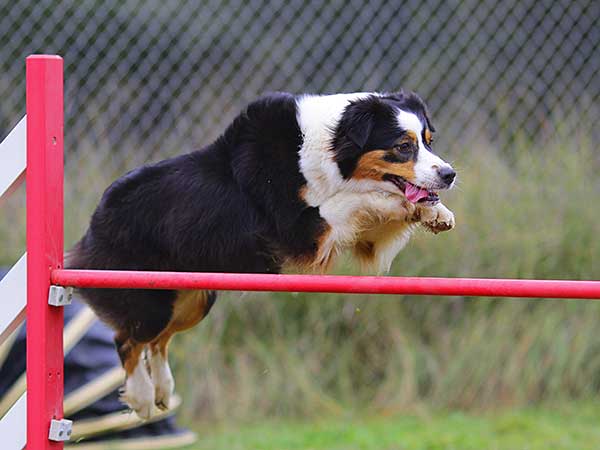
melounix / Dollar Photo Club
Bar jumps and other agility training equipment can be purchased inexpensively or made yourself if you are a DIYer.
Another of the most common types of dog agility jumps is the tire jump. While they are called tire jumps, the name can be deceiving. In most cases, the hoops used for these jumps have no relation to an actual tire except for their shape.
The opening is larger than that of a standard tire, usually 24" in diameter and as with the bars, the height is adjustable. Hoops can be made from a range of materials including foam and lightweight plastic tubing. Again the idea is to provide your dog with a challenge without increasing the potential for injury.

One of the more intriguing but lesser known of the agility dog jumps is the broad or long jump. This style of jump is not used as often in agility competition but can provide your dog with yet another level of agility skill. These jumps involve a series of boards set up one immediately after the other within four marker poles. The goal is to get your dog to jump over the boards between the marker poles. This tests your dog's ability to jump for distance as well as height.
Range Of Prices For Dog Agility Jumps Depending On Type And Quality
Jumps can range in price from $30 or $40 for basic, plastic models to several hundred dollars for better quality models and larger sets. You can buy individual jumps or sets of a single type or multiple types of jumps to challenge your dog even more. No matter how much you spend, the effectiveness of the jumps will depend on the amount of work you and your dog put into training.
Get the jump on the competition or just get a good workout for you and your dog by buying your own set of agility jumps and you can find out what the buzz around agility training is all about.
Agility Dog Jump Training Tips
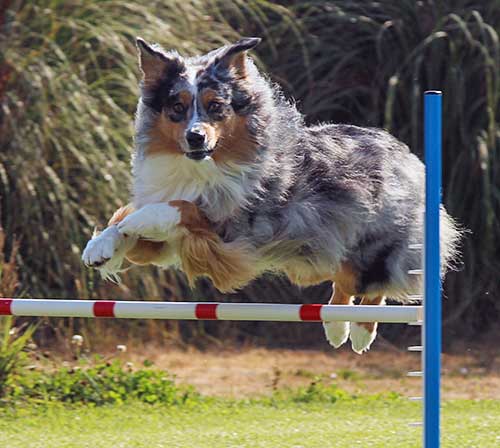
Devery Wallace
You'll have to take it easy with younger dogs and puppies. Their bones are still developing and their growth plates still haven't closed completely. When starting keep the bar on the ground or very low.
Let your dog get used to the bar. Let them check it out then entice them over the bar with a treat. Slowly raise the bar until they get the idea of going over the bar.
If your dog is old enough to start jumping you can keep raising the bar until you reach their regulation jump height.
You can tell if you are raising the bar too quickly if your dog keeps knocking down the bar. Just back off a bit and give them time to adjust. As their jumping skills improve you can raise the bar a bit again later.
When training your dog on the agility bar jump (or any other dog agility equipment) it is important to be consistent with the command you use. Common ones are Jump, Over, Up and Hup. Pick a word and stick with it so you and your Aussie don't get confused later in the heat of competition.
United States Dog Agility Association, Inc. (USDAA)


Have Dog Training Questions?
Check out these introductory dog training videos...
I want my dog to stop being aggressive.
I want some help training my new puppy.
I want my dog to stop barking at everything.

Get Australian Shepherd Info, Website Updates, Special Offers, and Cartoons...
FREE GIFT
You'll also receive a free copy of the ebook
My Everyday Dog Training Tools
by professional dog trainer Daniel Abdelnoor, "Doggy Dan"