- Home
- Navigation ⌄
- Aussie Owner's Manual
- Guide To Australian Shepherd Training & Care
- What's New?
- New Articles
- New Forum Posts & Articles
- Forums
- Create a Page About Your Aussie
- Question & Answer
- Aussie Art
- Rainbow Bridge
- Aussie Mix Forum
- Training
- Training Your Aussie
- Dog Training Videos
- Dog Sports
- Wide World of Dog Sports
- Agility Training
- Getting an Aussie
- Aussie: Right For You?
- Aussie Rescue
- Choosing a Breeder
- Aussie Breeders Directory
- Aussie Puppies For Sale
- MAS Breeders Directory
- MAS Puppies For Sale
- Puppy Care
- Favorite Puppy Names
- Care & Feeding
- Dog Nutrition
- Best Dog Food Brands
- Best Bully Sticks
- Dog Food Ingredients
- Raw Dog Food Diet
- Dog Grooming
- Stuff for Your Aussie
- Dog Supplies & Products
- Dog Collars & Harnesses
- Popular Pages ⌄
- Recommended ⌄

Australian Shepherd Breed Standard
Aussie vs. Mini Aussie Breed Standard
Although Aussies and Mini Aussies are considered to be separate breeds the Australian Shepherd Breed Standard is effectively the same for both except, of course, for the size requirements.
This information should be read as applying to both except where specifically noted otherwise.
General Appearance
The Australian Shepherd is a medium sized dog (Minis, small to medium), slightly longer than tall. He exhibits the characteristics of an exceptional herding dog: strength, stamina, alertness, quick reflexes and remarkable agility. The Aussie should not appear cumbersome or fragile but of medium bone. Masculinity or femininity should be apparent in either sex. Another identifying feature of Aussies is their natural or docked bobtail. The coat is moderate in length and coarseness and there is a range of acceptable colors and patterns allowing for great variety and individuality.
Character
Bred as a working stock dog Aussies have strong herding and guarding instincts. They are exceptionally intelligent and loyal making great companions. Australian Shepherds are tireless and enthusiastic workers. Due to their protective nature they can be reserved with strangers but should not present as shy. Although they dominate their herds assertively, aggression or viciousness is not acceptable in the breed standard.
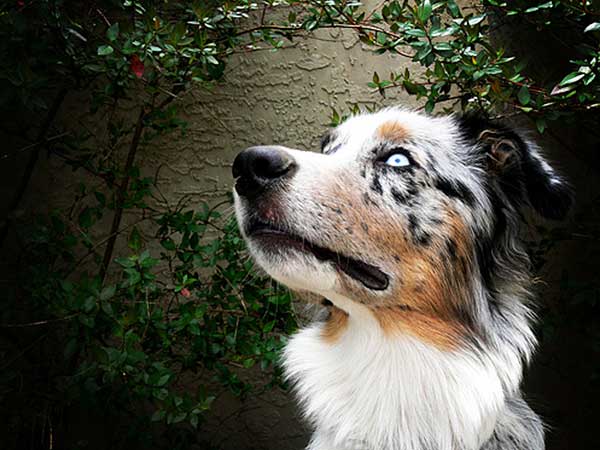
Used with permission of William McEwen, Aperitive Photography
"Aiden" intently watching a squirrel
Head
The head is clean cut, strong and dry. The size should be proportionate to the size of the body. The top line of the skull should be parallel to the line of the muzzle when viewed from the side. According to the Australian Shepherd breed standard the muzzle should be equal to or slightly shorter than the back scull in length with well defined stop, minimal tapering and rounded at the tip of the nose.
Expression: The expression should convey intelligence, eagerness and a friendly demeanor in its keen gaze.
Eyes: The almond shaped eyes can be brown, blue or amber with combinations. Flecks and marbling of colors are acceptable. Eyes should not be either prominent or sunken. Pupils should be dark, clearly defined and well positioned. Eyes should express intelligence and attentiveness.
Blue merles and blacks have black pigmentation around eye rims with black noses and lips while red merles and reds have liver or brown coloring in these areas. In red merles and reds it is permissible to have pink spots on the nose but they should not cover more than 25% of the area in dogs over one year old.
Ears: The triangular ears are set high on the head and should not be prick or hanging. When at attention the ears fall forward or to the side. For acceptable length the rounded tip of the moderatedly sized ear should reach around to the inside corner of the eye.
Teeth: A full compliment of strong white teeth should meet in a scissor or level bite and may not be undershot or overshot by more than 1/8 inch. More than this would be a disqualification. Teeth that are broken or missing as a result of accident are not penalized under the breed standard.

Neck and Body
The medium length neck is strong and firm and is in proportion to the rest of the body. It is slightly arched at the crest and fits well into the shoulders. The Aussie has a firm body with a level topline from withers to hip joints and a moderately sloping croup.
The deep chest and well sprung ribs appear well balanced and strong without being barrel chested or slab-sided. There is a moderate tuck-up in the bottom line.
As per the Australian Shepherd breed standard the straight tail is not to be longer than four inches whether it is a natural bobtail or docked.
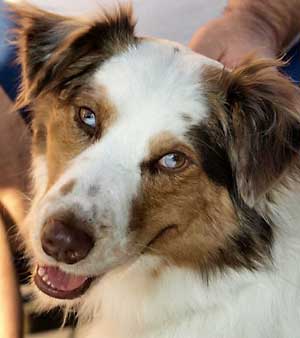
Carol Killgore
Jessie
with beautiful blue/brown
marbling in eyes conforms to the Australian Shepherd Breed Standard.
We adopted Jessie (3
years old) from Forgotten Friends Mixed Breed Rescue. He
is a pure bred red merle with exotic blue/brown eyes. He
had hip surgery early in life (2.5 years) and is a great
addition to our family. Yes he guards me, (mom) and was
a bit protective of me from my own family, but we've remedied
that with everyone taking part in his care. ~ Carol Killgore,
Austin, TX, USA
Send In Pics of
Your Australian Shepherd!
Forequarters
Shoulder blades are long, flat and close set at the withers. They are well laid back at about 45 degrees. The upper arm is at approximately 90 degrees to the shoulder line with legs dropping straight down perpendicular to the ground.
The elbow is about the same distance from the ground as it is to the withers. Legs are straight and strong with oval bones. Pasterns are of medium length, thick and strong with a slight slope.
Feet are oval in shape with close-knit and well-arched toes. Pads are thick and durable with strong nails. Dewclaws may be removed.
Hindquarters
Hindquarters and forequarters at the shoulders are about the same width. The angulation of the pelvis and upper thigh corresponds to the angulation of the shoulder blade and upper arm forming an approximate right angle. Stifles are clearly defined and hock joints are moderately bent.
Metatarsi are short and perpendicular to the ground. They should be parallel when viewed from the rear. Feet are oval in shape with close-knit and well-arched toes. Pads are thick and durable with strong nails. Dewclaws must be removed.
Coat
The coat has a medium texture and has straight to slightly wavy hair. The quantity of the undercoat varies with climate. The hair on the head, outside of ears, front of forelegs and below the hocks is short and smooth.
The backs of the forelegs are moderately feathered and the britches are moderately full. Moderate mane and frill that is more pronounced in dogs than in bitches. Non-typical coats are considered severe faults in the Australian Shepherd breed standard.
Color
Acceptable colors are solid black, solid red (liver), blue merle and red merle. These may all include white markings and/or tan (copper) points. There is no order of preference for colors. The blue merle and black have black pigmentation on the nose, lips and eye-rims while red merle and red have liver pigmentation in these areas.
A butterfly nose is not considered a fault under one year of age. No matter which color the areas surrounding the ears and eyes must be predominantly colored and cannot be white.
White coloring between the withers and tail and between the elbows and hindquarters on the sides (white body splashes), other than recognized colors and Dudley nose (pink coloration of nose leather) are disqualifications under the breed standard.
(For more information on white coloration in merle patterned Aussies read the article Homozygous "Lethal White" Merles.)
Gait
The gait is smooth, free and easy. It is very agile, well-balanced with a ground covering stride. The fore and hind legs move straight and parallel to the center line of the body. As speed increases both the front and rear feet converge toward the center line of gravity while the topline stays firm and level. The agility of the the Aussie allows them to change speed, direction and gait instantly.
Size
Australian Shepherd Breed standard referred height at the withers for males is 20 to 23 inches, for females 18 to 21 inches. However quality should not be compromised in favor of size.
North American Miniature Australian Shepherd Breed standard preferred height at the withers for males is 14 to 18 inches, for females 14 to under 18 inches. However quality should not be compromised in favor of size. Under 14 inches at the withers is considered a disqualification.
Other Australian Shepherd Breed Standard Disqualifications
Australian Shepherd: Monorchidism and cryptorchidism.
North American Miniature Australian Shepherd: Toy-like characteristics (i.e. domed head, bulging eyes, fine bone), monorchidism or cryptorchidism.


Have Dog Training Questions?
Check out these introductory dog training videos...
I want my dog to stop being aggressive.
I want some help training my new puppy.
I want my dog to stop barking at everything.

Get Australian Shepherd Info, Website Updates, Special Offers, and Cartoons...
FREE GIFT
You'll also receive a free copy of the ebook
My Everyday Dog Training Tools
by professional dog trainer Daniel Abdelnoor, "Doggy Dan"