- Home
- Navigation ⌄
- Aussie Owner's Manual
- Guide To Australian Shepherd Training & Care
- What's New?
- New Articles
- New Forum Posts & Articles
- Forums
- Create a Page About Your Aussie
- Question & Answer
- Aussie Art
- Rainbow Bridge
- Aussie Mix Forum
- Training
- Training Your Aussie
- Dog Training Videos
- Dog Sports
- Wide World of Dog Sports
- Agility Training
- Getting an Aussie
- Aussie: Right For You?
- Aussie Rescue
- Choosing a Breeder
- Aussie Breeders Directory
- Aussie Puppies For Sale
- MAS Breeders Directory
- MAS Puppies For Sale
- Puppy Care
- Favorite Puppy Names
- Care & Feeding
- Dog Nutrition
- Best Dog Food Brands
- Best Bully Sticks
- Dog Food Ingredients
- Raw Dog Food Diet
- Dog Grooming
- Stuff for Your Aussie
- Dog Supplies & Products
- Dog Collars & Harnesses
- Popular Pages ⌄
- Recommended ⌄



Guide To Controlling Fleas
WARNING To Australian Shepherd Owners
Many flea control products can pose a health hazard to your Australian Shepherd. Australian Shepherds are prone to a mutation of the MDR1 gene which results in dogs that are extremely sensitive to many chemicals and drugs. The MDR1 gene mutation can be fatal when affected Australian Shepherds are exposed to medications like Trifexis and Ivermectin (and many others) commonly found in flea, tick, and heartworm products. While some of those products are mentioned on this page for informational purposes only, DO NOT GIVE YOUR AUSTRALIAN SHEPHERD ANY MEDICATIONS UNLESS THEY HAVE BEEN APPROVED BY YOUR VETERINARIAN, AND YOUR VETERINARIAN IS FAMILIAR WITH THE MDR1 GENE MUTATION (some are not), AND YOUR DOG HAS BEEN TESTED FOR THE MDR1 GENE MUTATION. Just because someone else reports that they have not had a bad reaction when giving their Australian Shepherd a particular product DOES NOT mean it is safe for your dog.
Read more about the MDR1 gene mutation and dangerous drug sensitivities here.
Read more about DNA testing for the MDR1 gene mutation here.
Fleas are wingless insects that live on the blood of their hosts and spread many diseases. They can infest your Aussie but can also affect other mammals, including cats and humans, as well as birds.

Although there are about 2000 varieties of fleas common ones are:
Dog (Ctenocephalides canis),
Cat (Ctenocephalides felis),
Human (Pulex irritans),
Northern Rat (Nosopsyllus fasciatus),
Oriental Rat (Xenopsylla cheopis).
Don't be fooled by the names though. Any of these can affect dogs, cats and humans. This is why controlling fleas in your pets is so important. You are not only protecting your Aussie but you and your children as well.
They can pass on several serious diseases and parasites:
Plague caused by Yersinia pestis
Typhus caused by Rickettsia typhi
Haemobartonellosis—damage to red blood cells by Mycoplasma haemocanis
Tularemia caused by Francisella tularen
Tapeworm (Dipylidium caninum)
Dipetalonema reconditum—not serious but often mistaken for heartworm
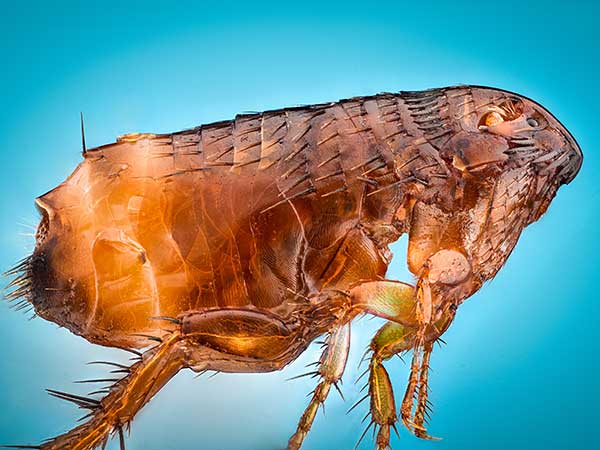
constantincornel / stock.adobe.com
Picture of flea at 10x magnification
Life Cycle Of Fleas
Depending on which species, a flea can live from a few months to a couple of years. It starts out as an egg laid by a female. Females can start laying eggs about two days after mating. She lays from 3—15 eggs at a time and can produce 30—50 in one day. That can add up to 400—1000 eggs in her lifetime (she doesn't lay eggs every day).
After two days or so the egg hatches and our flea moves to the next stage of its development—the larva. The larva feeds on feces or "flea dirt" left by its mother and begins to spin a cocoon.
In the cocoon it is at the pupa stage of development. Here it changes into its final form and emerges as an adult in about a week.
Fleas live on blood they suck from their hosts. They are well suited to life on a mammal or bird. They are about 1.5 to 3 mm (1/8 to 1/16 inch) in size and have hard bodies that are resistant to being crushed (by scratching) as well as narrow bodies to make movement through hair, fur or feathers easier.
Their long hind legs give them remarkable jumping abilities. They can jump 200 times their body length, about 30 cm or 1 foot. So they can easily hop from the carpet to your dog and from your dog to you.
Symptoms of an Infestation
Depending on the number of fleas, the age of your dog or puppy and its sensitivity symptoms can vary.
Bites can be irritating and will result in your dog scratching at the bitten area. This can escalate to severe itching with swelling and red lesions. Left unchecked this can result in ulceration and eventual hair loss.
In puppies, older dogs or sick dogs experiencing a severe infestation anemia is a possibility. Anemia is a lowering of the number of red blood cells and can result in death if not addressed.
You can tell if your dog has fleas because, well they will be scratching like crazy, and you will see the little critters in their fur often around the hindquarters or head. You might also detect "flea dirt", the excrement left by fleas. If moistened this will be a reddish brown color as it is made up of digested blood.
Want to learn more about how to get rid of fleas? Check out this in-depth guide.
Flea Allergy Dermatitis
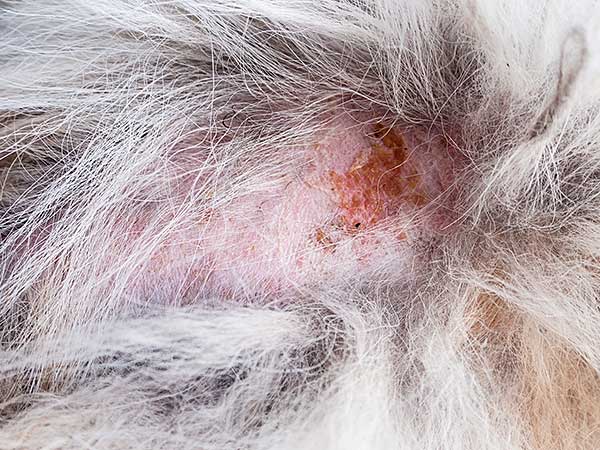
Watcharin / stock.adobe.com
Close-up of dermatitis on dog's skin.
Another serious reaction is flea allergy dermatitis. This is an allergic reaction caused by your dog being allergic to the saliva of the flea. The saliva contains various compounds to help prevent blood from clotting. Dogs that are allergic to the saliva will suffer intense itching and they will scratch incessantly. This can lead to hair loss, especially in the hindquarters.
If your dog shows signs of flea allergy dermatitis and they are hypersensitive to the saliva it is vital that you get the infestation under control. One single flea can bite your dog hundreds of times a day! You may have to move them out of the infested area and keep them away from all other animals that may also be infested.
They will not go away overnight and are difficult to get rid of. If you miss even one you could be right back where you started in no time. The math of flea reproduction is shocking. If you start with an infestation of 25 females after only a month you could have 250,000 of the little critters! So if you have noticed even one on your dog you don't have time to lose. Start to get rid of them immediately.
Infestation Control and Elimination
Prevention of an infestation is always preferred, of course, but what if it's too late and fleas have already made your dog into their new home?
When dealing with an infestation you can't just treat your dog. For every one you find on your dog there could be dozens, hundreds even, lurking in the carpets, on your furniture and in your yard.
The entire area will have to be cleaned. Anywhere your dog goes should be cleaned. Vacuum carpets thoroughly, especially in areas where your dog may brush up against drapes, walls or furniture. The dog bed should be cleaned at least twice in hot water and treated with an adult flea control product as well as an insect growth regulator (IGR). This can effectively interrupt the life cycle by preventing eggs laid from developing into larvae.
You can use a flea comb to try to get as many as possible. Wash them off in detergent water to kill them. You will want a comb with 32 teeth/inch. This is a good option for puppies, pregnant bitches or dogs that are ill and cannot be exposed to the chemicals in flea control products. This will not solve the problem but is one tool you can use to help reduce their population. It is time consuming and won't help a dog suffering from allergy dermatitis, but it's a step in the right direction.
You can give your dog a flea bath with commercially available products designed for the purpose such as a special shampoo or you can use baby shampoo. You can kill fleas by drowning them. However, if you sit your dog in a tub of water the fleas will flee to higher ground and rush toward your dogs head. So plan ahead and cut them off and don't give them that escape route. Be sure to create a barrier of thick shampoo lather around your dog's neck before you submerge their hindquarters or body.
Make sure to lather well from the neck down and have your dog sit in the water long enough to drown the fleas. You can only shampoo so much and have to be careful of sensitive areas on the head (ie. eyes) so some fleas may still survive. As with combing this is just another supplementary tool to help reduce the population.

What About the Commercially Available Products?
Washing, vacuuming, combing and shampooing alone is not likely going to be enough to eliminate fleas. It's time to bring out the big guns. Insecticides. While many disagree with using chemicals on principle this has to be weighed against the alternative.
It is possible for some dogs to be sensitive to the chemicals used in commercial flea control products. For these dogs natural alternatives my have to be tried. It is also not recommended to use some of these products with puppies under a certain age, pregnant bitches, or sick dogs. Always follow your vets advise and adhere to the manufacturers guidelines when using any of these products.
The health consequences of fleas can be severe, up to and including death. The chances for problems occurring are relatively small for most breeds that don't have drug sensitivities that can be fatal for many Australian Shepherds. Many commercial products are proven effective and provide a fairly sure method of eliminating infestations.
The two main kinds of products are those designed to treat the environment and those that are designed to treat the dog.
Environmental products include flea bombs or foggers. They send a fog of insecticide through your house and kill adults, eggs and larvae everywhere in carpets, drapes and furniture.
You and your pets have to be out of the house while it is going off, so be sure to have somewhere you can go for about 8 hours. Read the instructions carefully and follow them to the letter. Be careful about leaving things like food out as it can be contaminated by the chemicals. This includes your dog's food and water bowls.
Flea powders can be effective at killing adults, eggs and larvae in your carpet. They generally contain chemicals like boric acid and pyrethrin and are simple to use. You sprinkle them on your carpet and after a few days or a week just vacuum them up. They are fairly effective and as an added bonus they usually work on other insects as well.
Products that are designed to treat your dog (rather than the environment) include shampoos, as I already mentioned, and dips. Flea dips are solutions that you mix with water and then, you guessed it, you dip your dog in it. They are quite effective at killing adults.
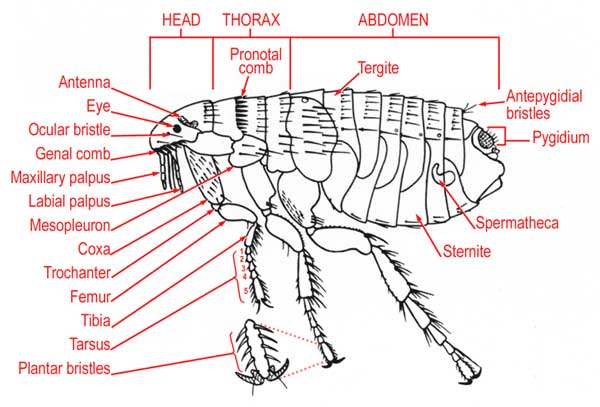
Centers for Disease Control
Anatomy of a flea
Flea Control Medications
There are many choices when it comes to flea control medications like sprays and drops as well as pills and shots. Frontline and Advantage are the biggest and most popular brands. Other options include Biospot, Capstar, K-9 Advantix, Program, Revolution, and Sentinel.
Most sprays and drops are effective against adults, eggs and larvae as they contain both an insecticide and a insect growth regulator (IGR). Some will also help control ticks, mosquitoes, and other parasites like heartworms.
The sprays and drops are fairly waterproof but will generally need to be reapplied about once a month. Always follow the advice of your vet and the manufacturer's instructions though.
When using sprays or drops you will also have to make sure your kids don't get the chemicals on them as they will absorb through skin. Some products like Revolution are a bit better in this regard as you wash them off after a couple of hours.
Another option is to use medications that are given in pill form or as injections. Pills are taken once a month and shots are given twice a year. Products like Program are slowly released through the skin where they affect fleas on the surface. However, this only sterilizes fleas interrupting their life cycle, it doesn't kill existing adults.
These products have specific restrictions on the age of dogs before you can apply them. Young puppies, pregnant bitches, older dogs or sick dogs can be at risk from exposure to these chemicals. Be sure to read the usage instructions carefully.
Another important factor when using these medications is the weight of your dog. These products have specific dosages based on your dog's weight. For example Frontline Plus for Dogs come in various dosages for dogs up to 22 lbs., 23-44 lbs., 45-88 lbs., and 89-132 lbs.
When using these chemicals—don't go overboard! Pick a product and try it. Don't get 5 products and bombard the fleas because you will also be bombarding your dog with chemicals that can have serious side effects.
When giving these medications always keep an eye on your dog to make sure they are not having an adverse reaction. This is rare but it can happen.
Natural Flea Control Remedies
Here are a couple of ideas to help control fleas in your yard. Eliminating them from your dog and house is great but if they just bring in more from outside you're back to square one.
Diatomaceous earth is a special soil made from crushed seashells. You and your dog won't be affected by this soil but fleas will hate it. Due to the crushed sea shells, diatomaceous soil contains microscopic sharp edges that slice through the hard exterior of fleas and other insects. This causes them to dehydrate and makes them susceptible to bacteria and other parasites.
However, if you want to have certain insects living in your yard this might not be the best approach for you.
You will also have to reapply occasionally as rain will wash it away making it less effective. But if you are looking for a relatively inexpensive and completely chemical free way to deal with fleas this may be a good option to consider.
Another natural approach involves using nematodes. What's a nematode? A nematode is just a worm, in this case a beneficial worm. These are tiny little worms and you spread them in your yard where they kill insects. Don't worry these worms can't live in you or your dog as your body temperature is too high for them.
These worms are completely natural and probably already live in your yard. By adding more you increase the concentration and make your yard very inhospitable to insects creating a "no flea zone".
Flea traps are another option that do not use chemicals. A trap generally has a heat source that draws them in. They think that the heat means a blood supply, but when they hop onto the trap they fall onto a glue surface and are stuck there. This is only a partial solution as it will only work on adults. It won't help with eliminating eggs or larvae.
Although the chemical versions may be more effective there are herbal flea collars available. If you have tried these please let me know how well they worked for you.
Prevention: The Best Approach
So you've finally gotten rid of the little pests and don't want to see them again, or you haven't had a problem with fleas and never want to. Prevention is the preferred method of dealing with infestations.
Flea collars, although perhaps not strong enough to kill adults, are still effective at controlling the development of eggs and larvae. Other products like Program provide similar protection by sterilizing them with preventative medications taken in pill form or by injection.
Be sure to give your dog a flea bath every once in a while, especially when they have come in contact with other dogs or environments you are unsure of. You may have an army of nematodes protecting your yard but what about the dog park?
Frequently grooming your dog with fine toothed comb will alert you to any outbreaks at an earlier stage. Better to know about fleas when there is just one rather than a hundred (or a thousand!).
Whether you are preventing an infestation or are fighting one it is important to remember that you have to deal with fleas both on your dog and in your environment—both indoors and out. You also have to consider the life cycle and eliminate them at all stages—egg, larva and adult. Hopefully this information will help you and your Aussie lead a flea-free life.
If you haven't already, be sure to read this article which explains the danger of treating your Australian Shepherd with many of the drugs and chemicals commonly used for flea, tick, and heartworm products:
MDR1 Gene Mutation Causes Dangerous Sensitivity To Many Drugs In Australian Shepherds


Have Dog Training Questions?
Check out these introductory dog training videos...
I want my dog to stop being aggressive.
I want some help training my new puppy.
I want my dog to stop barking at everything.

Get Australian Shepherd Info, Website Updates, Special Offers, and Cartoons...
FREE GIFT
You'll also receive a free copy of the ebook
My Everyday Dog Training Tools
by professional dog trainer Daniel Abdelnoor, "Doggy Dan"