- Home
- Navigation ⌄
- Aussie Owner's Manual
- Guide To Australian Shepherd Training & Care
- What's New?
- New Articles
- New Forum Posts & Articles
- Forums
- Create a Page About Your Aussie
- Question & Answer
- Aussie Art
- Rainbow Bridge
- Aussie Mix Forum
- Training
- Training Your Aussie
- Dog Training Videos
- Dog Sports
- Wide World of Dog Sports
- Agility Training
- Getting an Aussie
- Aussie: Right For You?
- Aussie Rescue
- Choosing a Breeder
- Aussie Breeders Directory
- Aussie Puppies For Sale
- MAS Breeders Directory
- MAS Puppies For Sale
- Puppy Care
- Favorite Puppy Names
- Care & Feeding
- Dog Nutrition
- Best Dog Food Brands
- Best Bully Sticks
- Dog Food Ingredients
- Raw Dog Food Diet
- Dog Grooming
- Stuff for Your Aussie
- Dog Supplies & Products
- Dog Collars & Harnesses
- Popular Pages ⌄
- Recommended ⌄



Australian Shepherd History
The history and origin of the Australian Shepherd breed is not as clear cut as we might like it to be. The breed we now think of as the Australian Shepherd wasn't recognized until 1957 with the formation of the Australian Shepherd Club of America (ASCA). At this time the National Stock Dog Registry (NSDR) served as the official breed registry until the ASCA took over in the 1970s.

In fact the current breed description wasn't written until 1977. This description of what an Australian Shepherd should look like (or its conformation) is what breeders now strive to achieve in their breeding programs.
The Australian Shepherd breed was not recognized by the American Kennel Club (AKC) until as late as 1993. Even though the ASCA developed the first breed standard they decided against joining the AKC due to what was considered too much weight being given to issues of conformity and not enough to performance. The Australian Shepherd was bred to be a working dog after all.
Those who felt recognition by the AKC was still desireable started the United States Australian Shepherd Association (USASA). They developed a breed standard of their own and joined the AKC and the Australian Shepherd was officially recognized as a breed on January 1, 1993.
So, Where Did Australian Shepherds Come From?
What happened before the 1950s that brought together the genetic magic that created the Aussie? Most of the stories agree that the development of the Australian Shepherd occured during the land rushes of the late 1800s.
Settlers from across Europe, including shepherds from Great Britain, Scotland and Spain as well as Australia and Latin America emigrated to North America. Many shepherds brought with them their favourite herding dogs to help manage the flocks of sheep that came with the massive influx of settlers. These flocks of sheep did include many from Australia.
Although shepherds, sheep and herding dogs did arrive in North America from Australia it is generally believed that the ancestors of Australian Shepherds were from either the Basque Region of the Pyrenees Mountains of Spain or from Germany. But there is contention about the Spanish connection. Although shepherds and highly prized Spanish sheep were shipped to Australia (and then to North America) it seems the dogs used by Basque shepherds were substantially different from the Australian Shepherd of today.
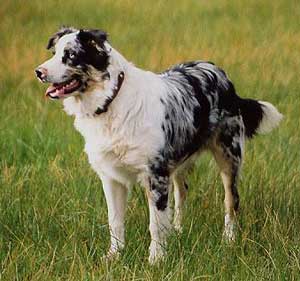
Courtesy Koolie.org
Australian Koolie Snowy
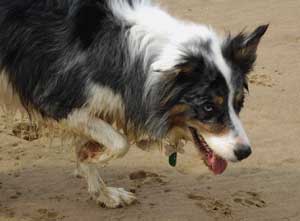
Border Collie
The Spanish dogs were smaller and leaner, while their coats were wire haired and without white coloring. It is uncertain to what extent these dogs form the history and origins of the Australian Shepherd breed. Once Basque shepherds were in Australia it is likely that their dogs were bred with other herding dogs appearing there during this time.
For example, an argument can be made for sheep herding dogs from Germany known as German Tigers. These dogs were brought into Australia in the early 1800s and were referred to by the Australians as German Koolies or German Coolies and are also known today as Australian Koolies. They are much more similar in appearance to our Australian Shepherds than the Basque dogs.
The Australian Koolie is described as having merle markings in blue, red and tri-color with solid red and black coats often containing white bibs, collars and face markings. Eye colors of the Australian Koolie can be hazel brown, black and blue (as well as combinations). Sound familiar? It is likely, however, that several other breeds went into the mix.
Dogs from Britain and Scotland such as the Scotch Collie, Border Collie and English Shepherd have all been identified as likely contributors to the gene pool of Australian Shepherds.
Australian Shepherds—"Made in America"
Whatever the historical origin, once they arrived in North America these dogs were prized for their sheep herding skills. During this time working farm dogs were bred more for function than conformity to a standard. Depending on the terrain and weather conditions American stockmen bred herding dogs to suit their conditions.
The qualities of strong herding and guarding instincts, exceptional intelligence, alertness and high energy that we love in our Aussies today came directly from a practical need for these traits in working stockdogs. The Australian Shepherd was actually "Made In America" by American stockmen.

For this reason the name 'Australian Shepherd' is somewhat of a misnomer. A more accurate name would be 'American Shepherd'. In fact the Australian Shepherd is not even recognized in Australia as a native breed.
What About Mini Aussies? Where Do They Fit In?
Where do Mini Aussies fit in? Smaller spaces of course! (Sorry, I couldn't resist that one.) The history and origin of the Mini Aussie is closely tied to the Australian Shepherd. Miniature Australian Shepherds were bred from Australian Shepherds and they have a shared history.

Courtesy Valhalla-Aussies
Cordova Spike
A woman named Doris Cordova from Norco, California began breeding Australian Shepherds with the aim of developing a miniature size variation in 1968. Her motivation was to create a dog with the characteristics that made the Australian Shepherd great, but in a package small enough (under 17") to better allow them to be house dogs and to make travel to stock shows easier.
One of the most well known dogs from her Cordova kennel was "Cordova Spike" who was placed with Miniature Australian Shepherd enthusiasts, Bill and Sally Kennedy. They continued to develop the miniature at their B/S kennels.
Not long after, another breeder, Chas Lasater of Valhalla Kennels also began to produce Mini Aussies. Cordova, Lasater and the Kennedy's were instrumental in the creation of the breed.
Good Things Come in Small Packages
This much smaller Aussie proved to be very popular and in 1990, the Miniature Australian Shepherd Club of the USA (MASCUSA) was formed. MASCUSA was able to garner recognition for the Miniature Australian Shepherd from the American Rare Breeds Association (ARBA).
However the Miniature Australian Shepherd never showed with the Australian Shepherds in ASCA. If a dog was registered with the Australian Shepherd Club of America (ASCA) and had an ASCA pedigree and was below the "preferred height" per the Breed Standard they could show since there is no size disqualification. However, if they were registered as a Mini only they were never allowed to show in ASCA. If an ASCA dog is registered as a Mini, ASCA revokes their papers because the ASCA considers the Miniature Australian Shepherd a different breed entirely.
In 1993 the AKC offically recognized the Australian Shepherd. Due to the policies of ARBA to not permit showing of dogs with the same name of AKC recognized breeds MASCUSA had to change the name of their Minis to avoid confusion between the now separate breeds.
The name 'Miniature Australian Shepherd' was changed to 'North American Shepherd'. That seems simple enough, but MASCUSA also changed it's name to reflect this change to North American Miniature Australian Shepherd Club of the USA (NAMASCUSA). It was quite a mouthful, but it retained the connection to the 'Australian Shepherd' legacy.
Then in 1998 as a result of a policy change by ARBA, it was decided by NAMASCUSA to revise the name again, this time to 'North American Miniature Australian Shepherd'. Whew!
But wait there's more... maybe I'll just let the now MASCUSA explain—from their website:
The Miniature American Shepherd Club of the USA (MASCUSA) was selected in May 2011 as the parent club of the Miniature American Shepherd for the American Kennel Club. The breed was formed by a split of the Australian Shepherd breed in AKC, and the incorporation of dogs previously known as Miniature Australian Shepherds and also known as North American Shepherds. MASCUSA was originally known as the Miniature Australian Shepherd Club of the USA, and then the North American Miniature Australian Shepherd Club of the USA, and was founded in 1990 as original parent club for the Miniature Australian Shepherd. MASCUSA represents AKC Miniature American Shepherd breeders and owners across America and around the world.
It is important to note, however, that not all Miniature Australian Shepherd breeders have joined with MASCUSA and embraced the new name "Miniature American Shepherd," its standards or AKC association. So there are now three separate breeds—Australian Shepherd, Miniature Australian Shepherd and the Miniature American Shepherd (Update: and now "North American Shepherd"). I strongly advise due diligence in investigating both the breed and the breeder to make sure you choose the right dog for you.


Have Dog Training Questions?
Check out these introductory dog training videos...
I want my dog to stop being aggressive.
I want some help training my new puppy.
I want my dog to stop barking at everything.

Get Australian Shepherd Info, Website Updates, Special Offers, and Cartoons...
FREE GIFT
You'll also receive a free copy of the ebook
My Everyday Dog Training Tools
by professional dog trainer Daniel Abdelnoor, "Doggy Dan"