- Home
- Navigation ⌄
- Aussie Owner's Manual
- Guide To Australian Shepherd Training & Care
- What's New?
- New Articles
- New Forum Posts & Articles
- Forums
- Create a Page About Your Aussie
- Question & Answer
- Aussie Art
- Rainbow Bridge
- Aussie Mix Forum
- Training
- Training Your Aussie
- Dog Training Videos
- Dog Sports
- Wide World of Dog Sports
- Agility Training
- Getting an Aussie
- Aussie: Right For You?
- Aussie Rescue
- Choosing a Breeder
- Aussie Breeders Directory
- Aussie Puppies For Sale
- MAS Breeders Directory
- MAS Puppies For Sale
- Puppy Care
- Favorite Puppy Names
- Care & Feeding
- Dog Nutrition
- Best Dog Food Brands
- Best Bully Sticks
- Dog Food Ingredients
- Raw Dog Food Diet
- Dog Grooming
- Stuff for Your Aussie
- Dog Supplies & Products
- Dog Collars & Harnesses
- Popular Pages ⌄
- Recommended ⌄



How Whipworms Can Affect Your Australian Shepherd
Whipworms (Trichuris vulpis) are one of the main types of worms to infect dogs. Unlike many other worms whipworms are not transmissible to humans or cats. They are relatively small, only about a half inch (30–50 mm) in length.

Their heads are at the narrow end while their tails, containing the reproductive system, are enlarged and thicker giving them a 'whip' like shape.
While many other worms prefer the small intestine the whip worm makes its home in the large intestine, or more specifically, the cecum. The cecum is the part of the large intestine where it meets the small intestine.
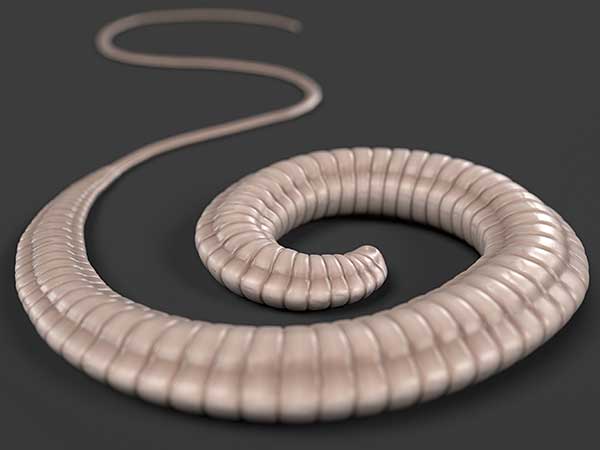
3drenderings / stock.adobe.com
3D rendering of a whipworm (Trichuris vulpis).
When a whipworm produces eggs they are passed in the stool but they need 2–4 weeks to develop embryos that are infectious. When these eggs are ingested from contaminated soil they make their first stop in the small intestine.
Once there the egg hatches and a larvae is released. This larvae embeds itself into the tissue of the small intestine. After about a week it emerges into the small intestine where it is swept down to the cecum of the large intestine.
Now it embeds itself in the tissue of the cecum and grows. In 60–70 days from the time of initial infection the young whipworm is sexually mature and the next cycle begins.

Whipworm Symptoms Can Vary From Mild To Severe
Depending on the number of whipworms present symptoms can be mild to severe. Agitation and inflammation because of too many worms will result in bloody diarrhea. Anemia and dehydration can also occur.
Since female whipworms lay eggs only intermittently, unlike many other worms that lay them continuously, it can be difficult to diagnose because you will not always be able to find eggs in tested fecal samples. Even if whipworms are present in the intestine results can come back negative. So you may have to check a few times before you find them.
Treatments for whipworm are available but they have to be repeated after about 75 days in order to be effective. This allows time for maturation of larvae that may have been present at the time of the first treatment. Your vet can advise you about the best course of action and schedule to follow.
For more information about Aussie health issues see the Australian Shepherd Health & Genetics Institute (ASHGI).


Have Dog Training Questions?
Check out these introductory dog training videos...
I want my dog to stop being aggressive.
I want some help training my new puppy.
I want my dog to stop barking at everything.

Get Australian Shepherd Info, Website Updates, Special Offers, and Cartoons...
FREE GIFT
You'll also receive a free copy of the ebook
My Everyday Dog Training Tools
by professional dog trainer Daniel Abdelnoor, "Doggy Dan"